Outside AC Unit Not Running But Inside Is Blowing
If your outside AC unit is not running but the inside is blowing air, the indoor blower may be moving air while the outdoor condenser is not actually cooling. Start with safe checks: thermostat mode, breaker, outdoor disconnect, air filter, drain safety switch, and whether the outdoor fan tries to start.
Do not keep running the system for long if the outdoor unit is not working. The indoor fan can blow room-temperature air, but the outdoor unit is what releases heat from your home. If it stays off, the AC cannot cool properly.
Turn the system off and call a qualified HVAC technician if you hear loud buzzing, smell burning, see melted wiring, notice repeated breaker trips, or suspect a bad capacitor, contactor, fan motor, or compressor.
Quick Answer
Your outside AC unit may not be running while the inside blower works because of:
- Thermostat set incorrectly
- Fan set to On instead of Auto
- Tripped breaker
- Outdoor disconnect switch turned off
- Blown fuse near the condenser
- Clogged air filter
- Float switch triggered by a clogged drain line
- Bad capacitor
- Failed contactor
- Outdoor fan motor failure
- Compressor problem
- Low-voltage wiring issue
- Control board issue
Some checks are safe for homeowners. Electrical parts inside the outdoor unit are not.
Fast Diagnostic Table
| What You Notice | Possible Cause | First Safe Step |
| Indoor fan blows warm air, outdoor unit silent | Thermostat, breaker, disconnect, float switch | Check thermostat and power switches |
| Outdoor unit hums but fan does not spin | Capacitor or fan motor issue | Turn AC off and call a technician |
| Breaker trips again after reset | Electrical fault or compressor issue | Stop resetting it |
| Thermostat says Cool but condenser stays off | Thermostat signal, low-voltage wire, contactor | Check settings, then call service |
| Water around indoor unit | Condensate drain/float switch | Turn AC off and check drain pan area |
| Outdoor fan starts then stops | Capacitor, motor, overheating, control issue | Schedule HVAC diagnosis |
1. Make Sure the Thermostat Is Calling for Cooling
Start at the thermostat.
Make sure it is set to Cool, not Heat, Off, or Fan mode. Then lower the set temperature 3 to 5 degrees below the current indoor temperature.
Also check:
If the thermostat fan setting is On, the indoor blower can run even when the outdoor condenser is off. That can make it seem like the AC is working, but the air from the vents may not be cold.
For normal cooling, use Auto so the indoor blower runs during actual cooling cycles.
2. Check the Breaker Once
The indoor and outdoor parts of a central AC system may be on different circuits. That means the indoor blower can run even if the outdoor condenser has lost power.
Check your electrical panel for a tripped AC breaker. If it is tripped, you can reset it once.
Do not keep resetting a breaker that trips again. Repeated trips can point to a serious electrical issue, compressor problem, shorted wire, or failing component.
If the breaker trips again, leave it off and call a professional.
3. Check the Outdoor Disconnect
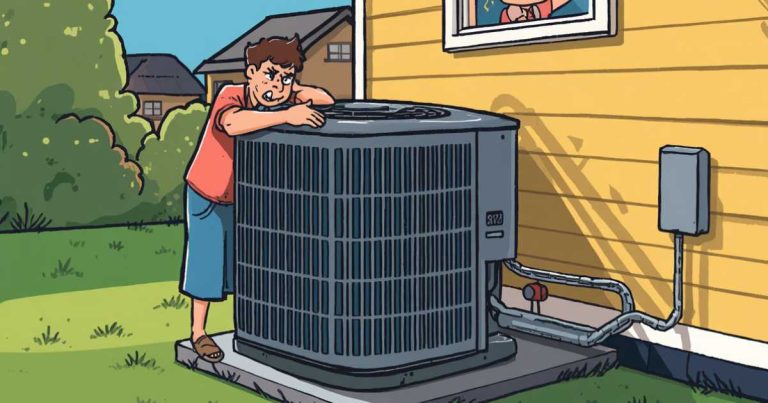
Most outdoor AC units have a disconnect box mounted near the condenser. This is usually a gray box on the wall close to the outdoor unit.
If the disconnect is off, loose, or not seated properly, the outdoor unit may not run.
You can visually check whether the disconnect appears to be in the On position. Do not open the condenser cabinet or touch wiring.
If the disconnect looks damaged, burned, loose, or wet inside, stop and call an electrician or HVAC technician.
4. Check the Air Filter
A clogged air filter does not always stop the outdoor unit by itself, but it can cause airflow problems, frozen coils, overheating, and safety shutdowns.
Turn the system off and check the filter.
Replace it if it is:
Restricted airflow can create cooling problems even if the indoor fan is still blowing.
For more general cooling symptoms, see our guide on why an air conditioner runs but does not cool the house.
5. Look for a Clogged Drain Line or Float Switch
Many AC systems have a float switch near the indoor unit or drain pan. If the condensate drain backs up, the switch may shut off cooling to prevent water damage.
In some systems, the indoor fan may still run while the outdoor unit does not start.
Look near the indoor air handler or furnace area for:
If water is present, turn the system off. A clogged condensate drain can cause ceiling damage, mold issues, or equipment problems.
6. Listen to the Outdoor Unit
Stand near the outdoor unit when the thermostat is calling for cooling.
Listen for:
What you hear matters.
If the unit is completely silent, it may not be receiving power or a cooling signal. If it hums but the fan does not spin, a capacitor or motor problem is possible.
Do not try to push-start the fan blade with a stick. That is unsafe and does not fix the underlying problem.
7. Bad Capacitor
A bad capacitor is one of the most common reasons an outdoor AC unit will not start.
The capacitor helps start and run the outdoor fan motor and compressor. If it fails, the outdoor unit may hum, click, or fail to start while the indoor blower keeps running.
Possible signs include:
Capacitors can store electrical energy even after power is turned off. This is not a safe DIY repair for most homeowners.
8. Failed Contactor
The contactor is an electrical switch inside the outdoor unit. It helps send power to the condenser when the thermostat calls for cooling.
If the contactor fails, the outdoor unit may not start even though the thermostat and indoor blower seem normal.
Possible signs include:
Do not open the outdoor electrical compartment to inspect the contactor unless you are qualified. This area contains high-voltage components.
9. Outdoor Fan Motor Problem
If the outdoor fan motor fails, the condenser cannot move air across the outdoor coil. The system may overheat or stop cooling.
Possible signs include:
Manufacturers such as Bryant and Carrier warn that many outdoor fan problems require professional diagnosis because the issue may involve motors, capacitors, wiring, or other electrical components.
10. Compressor Problem
The compressor is one of the most important and expensive parts of the AC system. If it does not start, the AC cannot move refrigerant through the system properly.
Compressor issues may cause:
Compressor diagnosis requires proper tools and training. If you suspect a compressor problem, call a qualified HVAC technician.
11. Low-Voltage Wiring or Control Board Issue
The outdoor unit needs a signal from the thermostat and indoor control system. If there is a problem with low-voltage wiring, the transformer, control board, safety switch, or thermostat signal, the condenser may not turn on.
This can happen even when the indoor blower still runs.
Possible clues include:
Do not repair control wiring unless you know what you are doing. Incorrect wiring can damage the system.
What You Can Safely Check Yourself
You can usually check:
Stop there if the issue is not obvious.
What Not To Do
Avoid these mistakes:
These shortcuts can create electrical shock, fire, compressor damage, or water-damage risks.
When To Call an HVAC Technician
Call a technician if:
Electrical and refrigerant-related AC problems are not good DIY repair areas.
Simple Troubleshooting Order
Use this order:
- Set thermostat to Cool.
- Lower the set temperature.
- Set fan to Auto.
- Check thermostat batteries.
- Check the breaker once.
- Check outdoor disconnect position.
- Replace a dirty filter.
- Look for water around the indoor unit.
- Listen to the outdoor unit.
- Call a professional if the outdoor unit stays off.
Final Verdict
If your outside AC unit is not running but the inside is blowing, the indoor blower is probably working while the outdoor condenser is not starting. The cause may be simple, like thermostat settings or a tripped breaker, but it can also be a capacitor, contactor, fan motor, compressor, safety switch, or wiring issue.
Start with safe checks only. If the outdoor unit hums, buzzes, trips the breaker, or will not start after basic checks, turn the AC off and call a qualified HVAC technician.
Frequently Asked Questions
Why is my inside AC blowing but the outside unit not running?
The indoor blower can run even when the outdoor condenser is off. Common causes include thermostat settings, tripped breaker, outdoor disconnect issue, clogged drain safety switch, bad capacitor, failed contactor, fan motor problem, or compressor issue.
Can I run my AC if the outside unit is not running?
No, not for long. The indoor blower may move air, but the system cannot cool properly without the outdoor unit. Running it can waste energy and may make some problems worse.
Why does my outside AC unit hum but not start?
A humming outdoor unit may point to a bad capacitor, stuck fan motor, compressor issue, or electrical problem. Turn the system off and call a technician.
Should I reset the breaker if the outside AC unit is not running?
You can reset a tripped breaker once. If it trips again, leave it off and call a professional. Repeated breaker trips can indicate an electrical fault.
Can a thermostat cause the outside AC unit not to turn on?
Yes. If the thermostat is set incorrectly, has dead batteries, is in delay mode, or is not sending the cooling signal properly, the outdoor unit may not start.
Is a bad capacitor a DIY repair?
For most homeowners, no. AC capacitors can hold electrical charge and are connected to high-voltage equipment. A qualified HVAC technician should test and replace them.
What should I check before calling an HVAC technician?
Check thermostat settings, fan mode, thermostat batteries, breaker position, outdoor disconnect, air filter, water around the indoor unit, and whether the outdoor unit is silent, clicking, humming, or trying to start.